Claude in Copilot moves into the EU Data Boundary: what changes
Microsoft will process Claude in Copilot and Cowork inside the EU Data Boundary by the end of 2026. What changes, what it doesn't cover (Foundry), and what to do now.

Finally! Microsoft has announced that by the end of 2026, Claude in Copilot and Copilot Cowork will be processed inside the EU Data Boundary. For many regulated organisations, the main compliance objection to Claude in Microsoft 365 Copilot goes away. And if you have already enabled it, there is nothing to do: processing moves automatically.
In this article, built on Microsoft's official announcement and its Microsoft Learn documentation, we explain exactly what changes, how the admin settings work today, what the announcement leaves out (Azure and Microsoft Foundry), and the steps we recommend for organisations in Spain and across the EU.
What Microsoft announced
On 5 November 2026, Charles Lamanna, Executive Vice President of Copilot, Agents and Platform at Microsoft, wrote on the Microsoft Copilot Blog that Anthropic's Claude models in Microsoft Copilot will process data within the EU Data Boundary, where that data is already stored. The key points:
- Scope: Claude across Copilot experiences, including Copilot Cowork. According to the post, Claude already powers Copilot Chat, Copilot in Microsoft 365 apps, Copilot Cowork and Copilot Code.
- When: available to organisations in the EU and EFTA by the end of 2026, with more detail promised as availability gets closer.
- No migration: organisations already using Claude in Copilot need to take no action. Processing moves automatically once available.
- Off by default: in the EU and EFTA the setting stays disabled by default. Admins can turn it on at any time, for all users or for selected users and groups.
Microsoft also notes that Claude joins other models already processing inside the EU Data Boundary, that enterprise data protection applies to Claude in Copilot, and that customer data is not used to train foundation models.
How Claude in Microsoft 365 Copilot works today
Until the change lands, it helps to be clear about the starting point. According to the Microsoft Learn page Claude models from Anthropic in Microsoft Online Services, updated on 4 November:
- Anthropic is a Microsoft subprocessor. The Microsoft Product Terms and Data Protection Addendum (DPA) apply, along with Enterprise Data Protection. The Customer Copyright Commitment covers Claude in products such as Microsoft Copilot and Copilot Studio.
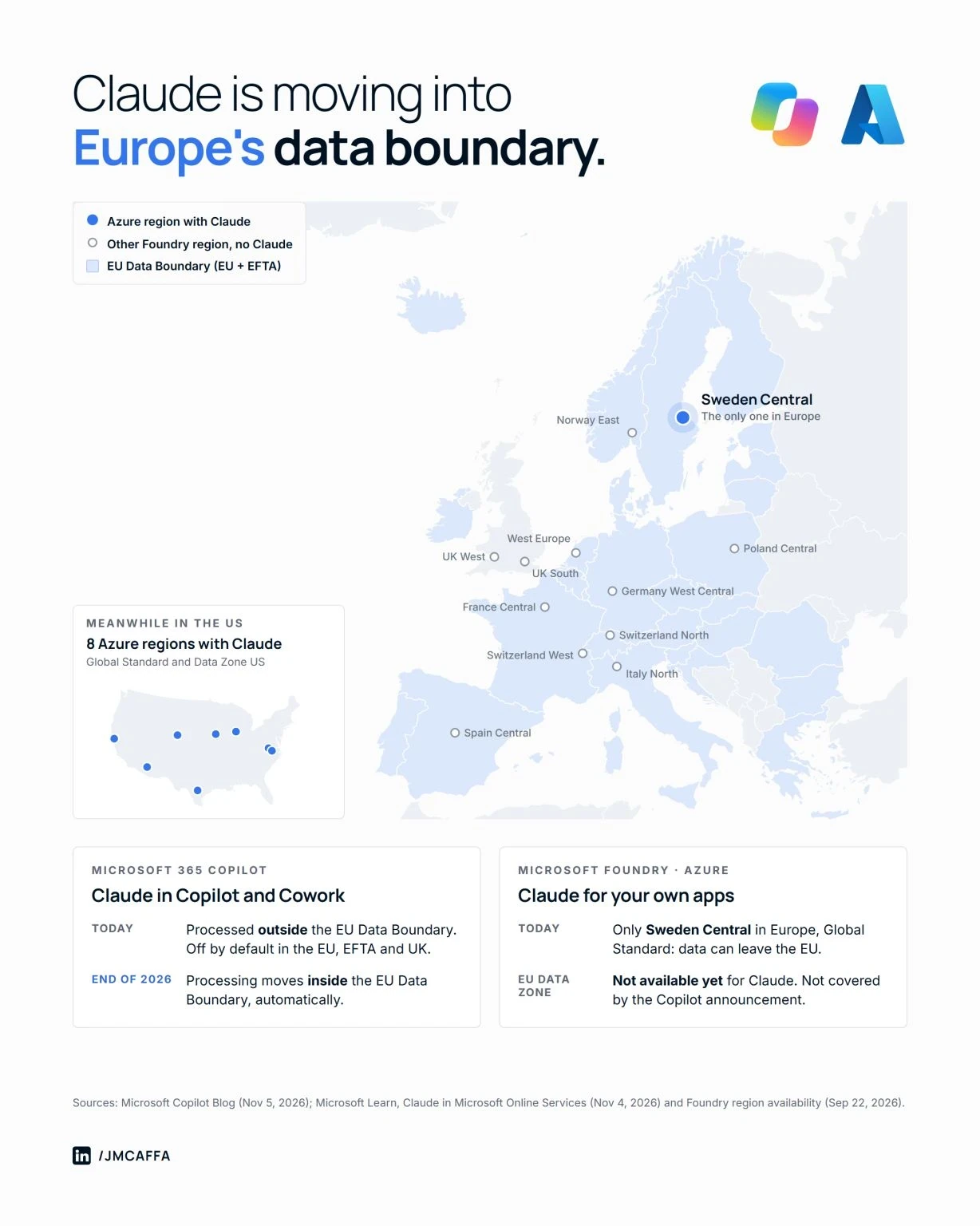
- Today, outside the EU Data Boundary. Claude in Microsoft Copilot, Researcher, Copilot Studio, Power Platform and Copilot in Microsoft 365 apps is "currently excluded" from the EU Data Boundary and from in-country processing commitments.
- Off by default in the EU, EFTA and UK. The AI providers operating as Microsoft subprocessors setting appears with the default set to No users.
- Who turns it on: someone with the AI Administrator or Global Administrator role, in the Microsoft 365 admin center under Copilot > Settings > View all > AI providers operating as Microsoft subprocessors. There you select Anthropic and choose which users or groups get access.
- Copilot Studio and Power Platform have additional controls in the Power Platform admin center once Claude is enabled in Microsoft 365.
- If you enabled Claude earlier under Anthropic's own terms in the EU, EFTA or UK, you need to opt in again: the toggle starts at Off.
One important nuance: Anthropic models with Data Retention work differently. They are off by default everywhere, require accepting Anthropic's commercial terms and DPA, and Anthropic acts as an independent processor that retains data. The EU Data Boundary announcement doesn't mention them, so treat them as a separate decision.
What the announcement doesn't cover: Claude in Azure Foundry
The announcement is about Claude in Microsoft Copilot. It says nothing about Azure or Microsoft Foundry, where Claude is used to build your own applications and agents. The picture there is different, according to Microsoft Learn's region availability table (updated 22 September):
- Sweden Central is the only European region with Claude. France Central, Germany West Central, Italy North, Norway East, Poland Central, Spain Central, Switzerland North and West, UK South and West, and West Europe don't offer it.
- Global Standard only. With that deployment type, requests can be processed in any Azure region, so data can leave the EU even when the resource sits in Sweden.
- No EU Data Zone for Claude. Data Zone Standard exists only for the United States, across eight regions, and the Europe tab reads "Not available".
- Two hosting options. According to Microsoft's hosting comparison, the Hosted on Azure version processes prompts and outputs on Azure infrastructure, while Hosted on Anthropic infrastructure may process data outside Azure. In both cases Anthropic is the seller and acts as an independent data processor under its own terms.
For custom builds with strict EU residency requirements, this calls for careful design: what data goes to the model, whether it is anonymised first, and which alternatives to use until a European Data Zone exists.
What about the UK?
The announcement refers to the EU and EFTA. The UK isn't mentioned, and the Learn documentation keeps it among the regions where Claude is off by default. Organisations with UK operations should review that tenant separately.
Practical steps for regulated organisations in Spain and the EU
This is what we are recommending to our clients while the change rolls out:
- Check where your tenant stands. Confirm whether Anthropic is enabled as a subprocessor, for whom and since when.
- Update your data protection paperwork. Review your record of processing activities and your DPIA to reflect Anthropic as a Microsoft subprocessor and the planned move to processing inside the EU Data Boundary.
- Scope it deliberately. Start with specific security groups rather than the whole organisation, and define which kinds of information can be used.
- Keep the decisions separate. Claude in Copilot, models with Data Retention, and Claude in Foundry are three different decisions with different contractual terms.
- Prepare your users. A new model in Copilot changes how people work with Researcher, Cowork, Excel or Word. Training makes the difference in adoption.
- Watch for Microsoft's confirmation. The announcement is a commitment for the end of 2026. Check Microsoft Learn for the moment the EU Data Boundary exclusion disappears from the documentation.
Our take at Adoptian
As a Microsoft Partner supporting Copilot and Claude adoption, we often see the same scene: teams keen to use Claude inside Microsoft 365, and a compliance function that, quite rightly, wanted processing to stay in the EU. This announcement unlocks that conversation for Copilot. For custom solutions on Foundry, architecture and data governance remain the key.
If you're planning the rollout, our AI adoption programs cover configuration, governance and training, and our agentic AI solutions are designed around European data protection requirements from day one.
FAQ
When will Claude in Copilot be processed inside the EU Data Boundary?
Microsoft says it will be available to EU and EFTA organisations by the end of 2026. As of 4 November, the Learn documentation still describes it as excluded.
Do I need to do anything if Claude is already enabled in Copilot?
No. According to Microsoft, organisations already using it need to take no action: processing moves automatically. If you originally enabled it under Anthropic's own terms, you do need to opt in again with Anthropic as a Microsoft subprocessor.
Does the change cover Claude in Azure Foundry?
No. The announcement is limited to Microsoft Copilot. In Foundry, Sweden Central is the only European region with Claude, on Global Standard, and there is no EU Data Zone.
Is Claude in Copilot on by default in the EU?
No. In the EU, EFTA and UK it is off by default, and an AI or Global Administrator has to enable it in the Microsoft 365 admin center.
Want to review your tenant and prepare a Claude in Copilot rollout with confidence? We'll sit down with you and work through it. Get in touch.