AI labs are moving into consulting: the 2026 market map
Anthropic and OpenAI are buying engineering talent and launching their own consultancies. We map where every player lands and what it means for European companies.
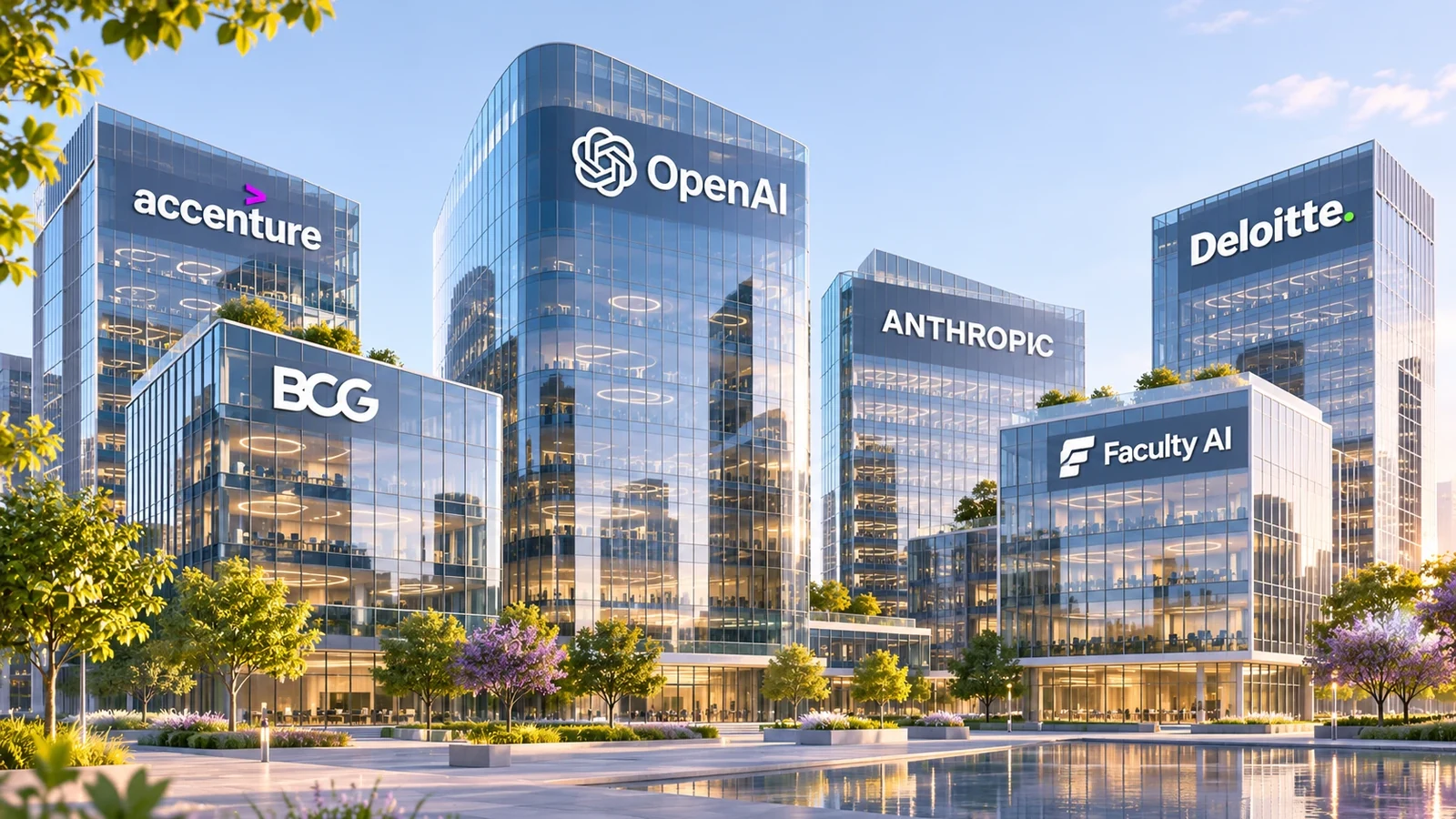
In 2002, IBM paid around $3.5bn for PwC Consulting. It was betting that the money lay in sitting next to the client. Twenty-four years later, the AI labs are making the same bet, only faster. This article walks through the moves of 2026, maps where each kind of AI consultancy lands, and explains what it means for companies in Spain and across Europe looking for an AI consulting partner.
2002: IBM's bet on sitting next to the client
IBM announced the purchase of PwC Consulting in July 2002 and closed it that October for about $3.5bn, according to its SEC filing, bringing in a consultancy of around 30,000 people. The logic was simple: hardware and software were becoming commodities, and the margin was in knowing the client's processes and delivering projects inside its walls.
AI is replaying that story. Models improve every few months and look increasingly alike in what they can do. What separates a rollout that works from one stuck in pilot is the integration work inside the business.
Six months that reshaped the AI consulting market
Between May and October 2026, both leading labs built their own services capability:
- Anthropic and Ode. In May an AI services firm backed by Anthropic, Blackstone and Hellman & Friedman was unveiled, with Goldman Sachs among the founding investors and about $1.5bn in capital commitments. That month it acquired Fractional AI, a San Francisco applied AI engineering firm, and in July it launched under its own name: Ode.
- The OpenAI Deployment Company. OpenAI launched it on 11 May with more than $4bn in initial capital, led by TPG with Advent, Bain Capital and Brookfield. Its 19 partners also include consultancies such as McKinsey, Bain & Company and Capgemini. The same day it agreed to buy Tomoro, with about 150 engineers, and in July it agreed to acquire Northslope, founded by former Palantir engineers.
- Anthropic and Hg in Europe. On 23 October the Financial Times reported that Anthropic and investor Hg are preparing an independent consultancy with offices in London and Berlin, due to launch before the end of 2026. Neither company has commented. By that Friday afternoon, Accenture's New York-listed shares were down more than 4%, according to City AM.
The incumbents are moving too. Accenture completed its purchase of Faculty, the UK AI firm with around 400 specialists, in March. Deloitte, PwC and KPMG have announced alliances with Anthropic to roll Claude out to their people and client work, and Accenture launched a forward deployed engineering practice with Microsoft.
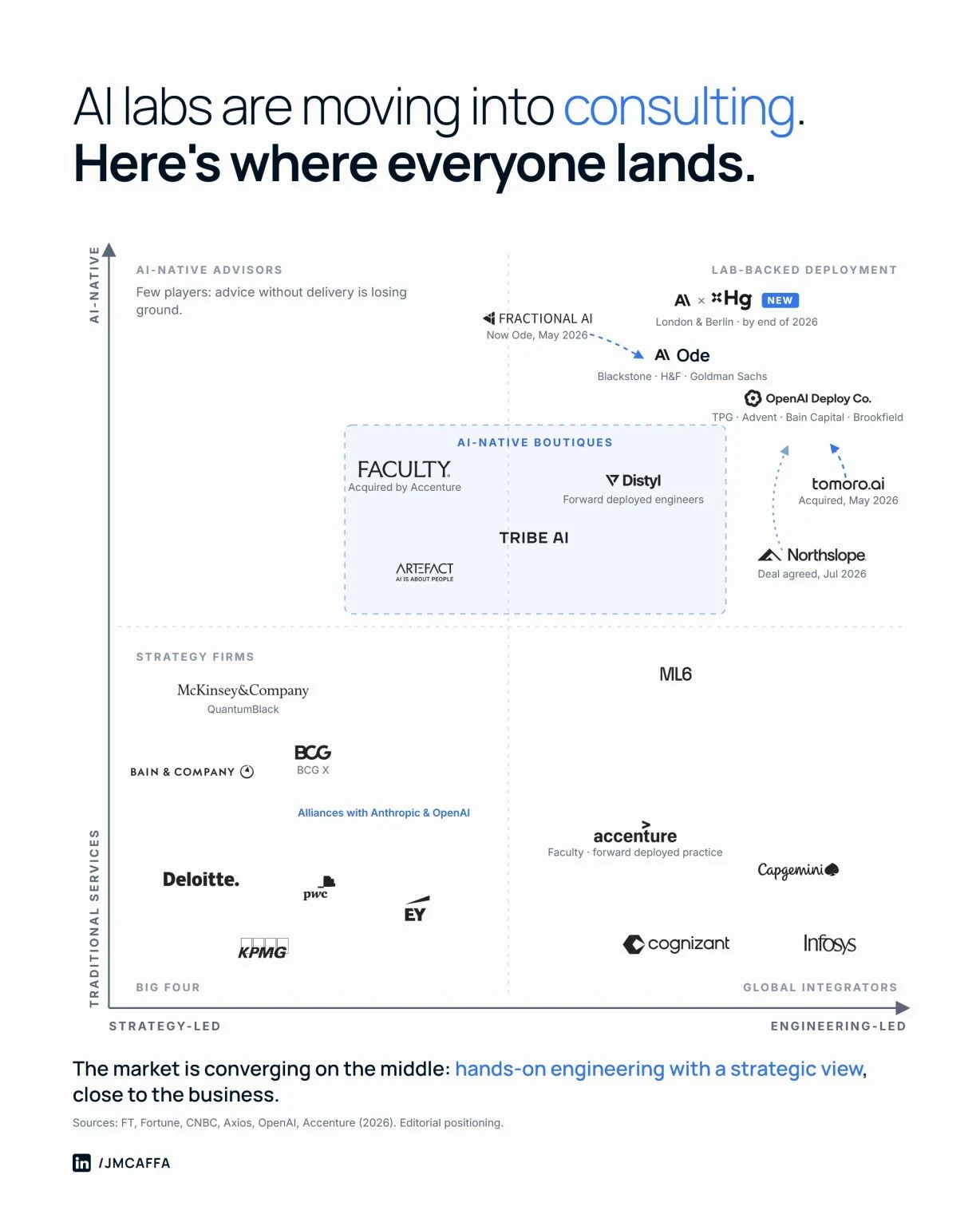
The map: where each AI consultancy lands
To make sense of the market we used two axes: AI-native to traditional services, and strategy-led to engineering-led. The positioning is editorial, based on what each player announces and how it works.
- AI-native advisors. Few players are left here. Advice without delivery is losing ground, and Fractional AI has ended up inside Ode.
- Lab-backed deployment. Ode and the planned Hg venture on Anthropic's side; the OpenAI Deployment Company, Tomoro and Northslope on OpenAI's.
- AI-native boutiques. Firms such as Distyl, which works with forward deployed engineers, Tribe AI and Artefact. Faculty sat here until Accenture bought it.
- Strategy firms. McKinsey with QuantumBlack, Bain and BCG X, with alliances with the labs. McKinsey and Bain are also partners in the OpenAI Deployment Company.
- Big Four. Deloitte, PwC, EY and KPMG, with large internal AI rollouts and alliances with the labs.
- Global integrators. Accenture, Capgemini, Cognizant, Infosys and ML6, combining scale with dedicated AI practices.
Why everyone is running towards the middle
Labs are buying engineering talent to get close to the business. Consultancies are buying it to stay relevant. Both are running towards the same place: hands-on engineering, with a strategic view, inside the client's processes.
There are solid reasons behind the move:
- Adoption is the bottleneck. Models can already do far more than most companies use them for. The value leaks out between the demo and the real process.
- Agents need integration. A useful agent needs data, permissions, connected systems and someone to tune it when the process changes.
- Consumption follows usage. For a lab, every use case that reaches production drives recurring usage, so investing to make that happen makes sense.
Our take: the winners won't be the ones with the best model or the biggest bench. They'll be the ones who can sit inside a real process and make AI work there, every day, long after the launch.
Will the labs cannibalise their own partners?
That's the open question. Consultancies investing in the OpenAI Deployment Company are funding a vehicle that partly competes with their own business. And Anthropic, which has alliances with three of the Big Four, is reportedly preparing its own European consultancy with Hg.
For now, the labs are focusing on specific accounts and segments: Ode reportedly targets mid-sized companies and its investors' portfolio companies, and the Hg venture, according to the FT, B2B software companies and other white-collar industries. Coexistence with partners for a while looks likely. The bar, however, has moved: any AI consultancy will need to show it can build and run solutions with the same technical depth as the model maker.
What it means for companies in Spain and Europe
For a European company looking for AI consulting, the map offers more options and more noise. A few useful questions before choosing:
- Who will actually be inside your process? Ask about the specific people, their production experience and their availability after launch.
- Are they model-neutral? A lab-backed firm will lean towards its own technology. That can be the right call, as long as you know it from the start.
- Do they know your regulatory context? Data protection, EU data residency and sector rules carry real weight in Europe.
- Do they fit your size? Large firms are built for large programmes. An AI boutique can move faster in a mid-sized company.
- Do they leave capability behind? The best rollout is one your own team can sustain and evolve.
Where Adoptian sits
Adoptian is a boutique AI consultancy in Madrid working right in that middle of the map. We design and build agentic AI solutions inside the client's processes, lead the adoption of Claude and Microsoft Copilot across teams, and stay on after go-live. We are a Microsoft Partner and a Lovable Certified Partner, and we work mostly with Spanish and European companies.
One example is our Bodegas Bordino case study: a multi-agent system that automates orders and delivery notes for a beverage distributor, built and tuned with the team that uses it every day.
FAQ
What is Ode, Anthropic's consultancy?
Ode is an AI services firm backed by Anthropic, Blackstone and Hellman & Friedman, with about $1.5bn in capital commitments. It was built on the acquisition of Fractional AI and embeds engineers inside client companies.
What is the OpenAI Deployment Company?
OpenAI's deployment unit, launched in May 2026 with more than $4bn in initial capital and majority-owned by OpenAI. It has agreed to buy Tomoro and Northslope to grow its forward deployed engineering team.
What is an AI-native consultancy?
A firm built around AI from day one, with teams that build and deploy solutions, rather than a traditional consultancy that has added an AI practice.
Does an AI boutique make sense compared with a large consultancy?
It depends on the size of the programme. For a mid-sized company, a boutique usually means more proximity, fewer layers and senior people inside the process from day one.
If you're choosing a partner for your next AI rollout, we'll sit down with you, review the case and tell you how we'd approach it. Get in touch.