What is a forward deployed engineer, and why does everyone want one?
Anthropic, Microsoft and Accenture are building forward deployed engineering teams. We compare the FDE with four other AI consulting roles by where their time goes.

This year Anthropic, Microsoft and Accenture are all building teams around the same job title: forward deployed engineer (FDE). Palantir made the name popular more than a decade ago, and many of us knew the job earlier as customer engineer or technical consultant. The brief has always been the same: sit with the client, understand how the work really gets done, and apply technology to re-engineer and optimise it.
This article explains what a forward deployed engineer does, how the role compares with other AI consulting roles, and what to look for if your company is hiring forward deployed talent for an AI rollout.
What is a forward deployed engineer?
A forward deployed engineer works inside the client's organisation, close to the people doing the work, and builds and runs solutions on top of a technology platform. You find them in the meeting with operations, at the desk of the billing team, and in the system logs when something breaks, rather than in a remote lab.
Three traits define the role:
- Proximity. They work inside the client's process, with access to its data, systems and users.
- Real building. They write code, wire up APIs, design agents and deploy. Recommendations alone are not the deliverable.
- Continuity. They stay after go-live to iterate, measure and fix things under real usage.
"Forward deployed" is military language for being stationed at the front line. Palantir used it for the engineers it sent to work inside its customers, and the label has now spread across the AI industry.
From technical consultant to forward deployed engineer
The title has moved on: technical consultant, then customer engineer, now forward deployed engineer. The substance has stayed put: sit with the client, understand the process, build what works in production.
The scale is what's new. In 2026 several of the biggest players in the market have bet on the role:
- Accenture and Microsoft launched a joint forward deployed engineering practice in March 2026, which they say will bring together "thousands" of AI-skilled engineers working directly with clients.
- Microsoft announced the Frontier Company in July: a unit of about 6,000 engineers and salespeople with a $2.5bn budget to design, deploy and run AI systems with customers, according to Directions on Microsoft.
- Anthropic is hiring Forward Deployed Engineers in its Applied AI team to embed with strategic customers.
- OpenAI, through its Deployment Company, agreed in July to buy Northslope to grow its FDE bench, as Axios reported.
When model makers and the largest integrators chase the same profile, the message is plain: the bottleneck for enterprise AI sits in getting it into the process far more than in the model itself.
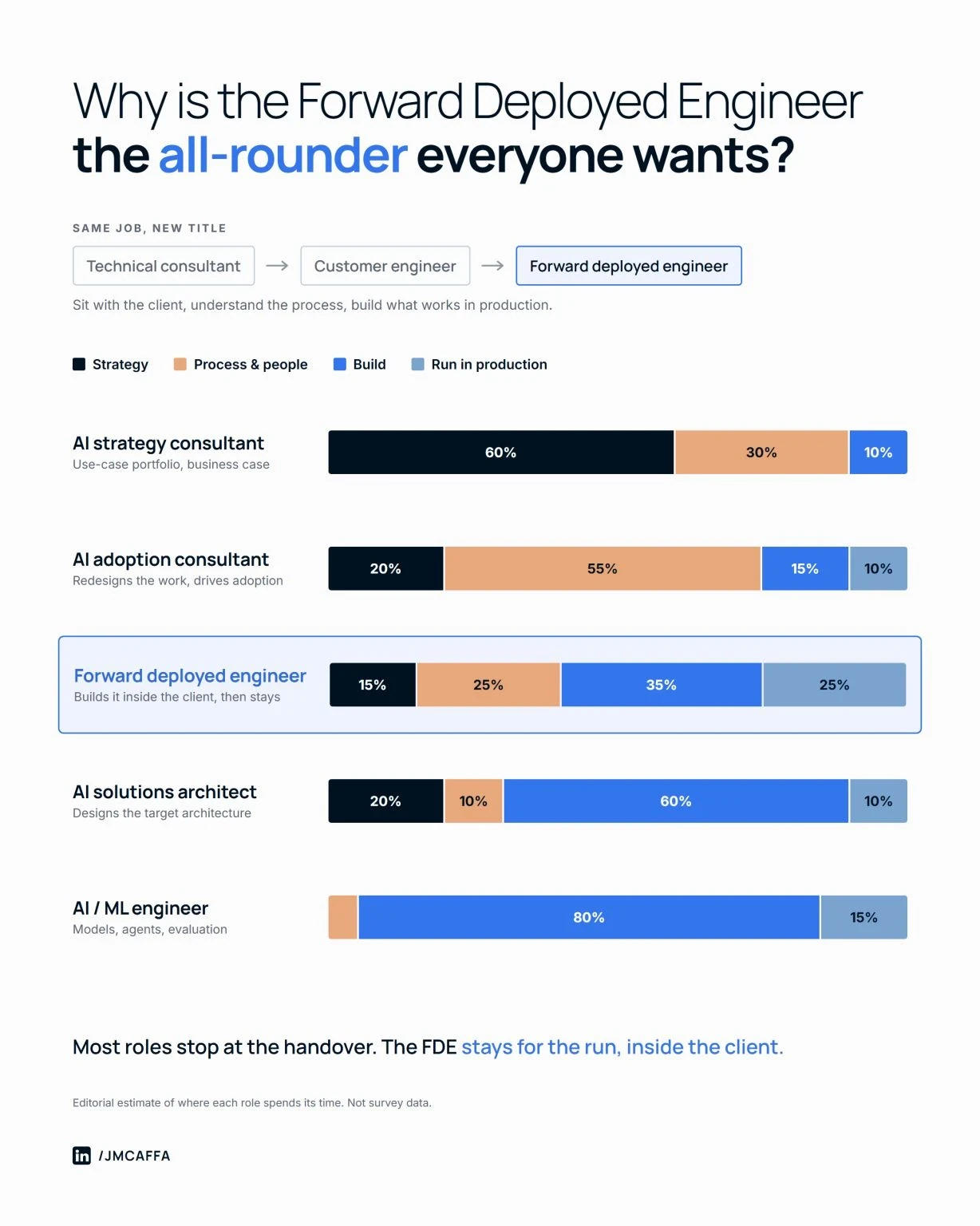
Five AI consulting roles, compared by where their time goes
To show what an FDE brings, we mapped five common AI consulting roles by how they split their time across four blocks: strategy, process and people, build, and run in production. The percentages are an editorial estimate based on our experience, not survey data.
- AI strategy consultant: 60% strategy, 30% process and people, 10% build, none in production. Sets the direction and the case for it.
- AI adoption consultant: 20 / 55 / 15 / 10. Works mostly with people: training, new habits, user communities.
- Forward deployed engineer: 15 / 25 / 35 / 25. The most balanced split of the five.
- AI solutions architect: 20 / 10 / 60 / 10. Designs the technical solution and how it fits existing systems.
- AI/ML engineer: about 5 / 0 / 80 / 15. Builds and tunes models, pipelines and evaluations.
Every role solves a different problem, so none of them is "better". What stands out about the FDE is that a quarter of its time goes into iterating on and running solutions after go-live.
Why the 25% in production matters
Most roles stop at the handover. The FDE stays for the evolution and the results, inside the client.
With generative AI and agents this matters even more than with traditional software. An agent that sorts orders or reads delivery notes looks great in a demo. In production you meet the odd formats, the exceptions nobody wrote down, and users who work with it in ways no one planned for. The first weeks in production are what turn a pilot into a tool the team relies on.
With AI the art of the possible is immense, yet there is still a long road from a nice demo to real impact. That road runs through production, with someone who understands the process and can change the code the same day.
What to look for when hiring forward deployed talent
For any company hiring "forward deployed" talent, the title on the CV tells you little. What matters is whether that person can talk to your COO in the morning and to users in the afternoon, and still find time to debug before the day ends.
Practical signals for assessing an FDE, in-house or from a partner:
- They have shipped something and kept it running. Ask for concrete examples of what changed after launch, and why.
- They explain the business process before the technology. If the first conversation is only about models, half the profile is missing.
- They know how to measure. They agree with the business what "working" means: cycle time, errors, volume handled without manual touch.
- They are fluent in security and compliance. In Europe, data protection, permissions and traceability belong in the design from day one.
- They leave capability behind. A good FDE documents, trains and prepares your people so the solution doesn't depend on them.
How we work at Adoptian
At Adoptian we work this way: inside the client, through go-live and after. We pair the design and build of agentic AI solutions with AI adoption programs, so the technology and the people move forward together.
One example is our Bodegas Bordino case study, a beverage distributor where we deployed a multi-agent system to automate order and delivery-note handling. Much of the value came in the weeks after launch, as we tuned the system to the real cases the team met every day.
A new role, or a good rebrand?
My personal view: the FDE is largely the consultant we always needed, with a new name and a far more powerful tool in hand. What has changed is the bar. With AI, the same person has to understand the business, design agents, handle sensitive data and stay on to run it all. That combination is still rare.
P.S. The percentages in the infographic are my editorial estimate, based on experience. Happy to be challenged on them.
FAQ
What is a forward deployed engineer?
An engineer who works embedded in the client's organisation to understand its processes, build technology solutions (today, mostly AI) and run them in production after launch.
How is an FDE different from a traditional AI consultant?
Strategy and adoption consultants spend most of their time defining and guiding. The FDE builds and stays to run things: by our estimate, around 35% of the time goes into building and 25% into iterating in production.
Which companies are hiring forward deployed engineers?
In 2026 they include Anthropic, Microsoft through its Frontier Company, Accenture through its joint practice with Microsoft, and OpenAI's Deployment Company.
Does a mid-sized company need its own FDE?
Not necessarily on the payroll. Many companies start with a partner working in FDE mode during the rollout, while training the internal team to own the solution afterwards.
If you're working out how to take AI from demo to daily operations, we'd be glad to sit down and look at your process with you. Get in touch.